
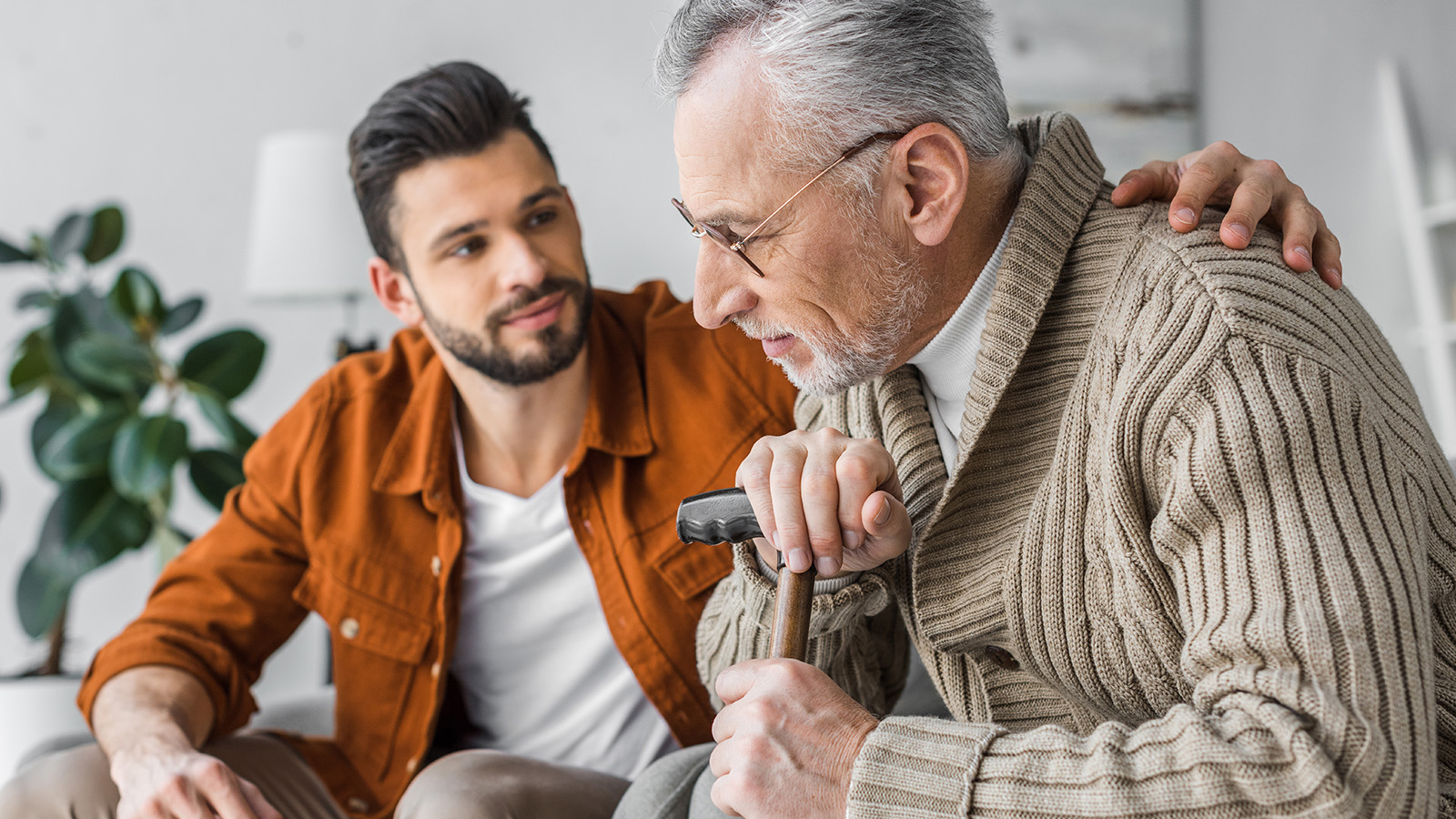
My dad had his jacket buttoned wrong last Sunday when he walked me to my car.
He’d gone back inside to get it—it was cold—and came out still talking, finishing a story about the neighbor’s fence that he’d started at dinner. I stood there with my keys in my hand while he got to the end of it.
The hug was longer than usual. The wave from the driveway went on until I turned the corner.
I drove home thinking about it for forty minutes.
He never used to do this. When I was growing up, he said goodbye from the kitchen—a wave from wherever he was standing, and that was that. The walk to the car is new. The extra story is new.
And I’d been letting it happen for almost a year before last Sunday, when it finally landed on me what it actually was.
It’s not a goodbye. It’s an ask for one more minute that he doesn’t know how to say out loud.
He spent forty years being the one nobody had to worry about
He’s the kind of father who handled things without making them into things.
School paperwork, car trouble, the insurance call that took three attempts—he did it and moved on and never brought it up again. When something went wrong in my childhood, my first thought was always that he would fix it.
I never thought to wonder what it cost him to be that kind of person.
He was also, for as long as I can remember, the one who was fine. He went to work, came home, and did it again. Somewhere in there, he coached teams and drove me to places and showed up for everything, and never seemed to be keeping score.
He was the one who made the big things feel manageable, and the small things feel handled, and it was so consistent for so long that I stopped registering it as something he chose to do.
It just seemed like how he was.
You don’t question that when you’re young. You absorb it as the condition of having him as a father.
I’m thirty-seven now. There’s no such thing as a person who needs nothing. There are just people who decided somewhere along the way that asking wasn’t their role—and who have been carrying that for so long they’ve stopped noticing the weight.
He handles things and never mentions that he handled them
My father called a plumber for me once without being asked.
I’d mentioned, in passing, a slow drip under the kitchen sink, and two weeks later, he called to say someone was coming by Thursday. He’d made the appointment, given them my number, and done it while I was thinking about something else entirely.
He never brought it up again.
This is how he has always operated—not loudly, not in ways that ask to be acknowledged. He notices what needs doing and does it, and the doing is the whole point as far as he’s concerned.
When my brother’s car died the week before his wedding, my father drove three hours to get him without telling anyone until he was already on the road.
He doesn’t tell these stories.
I used to take this for granted the way you take gravity for granted—not ungratefully, just without examining it. I understand now that a person can spend a whole life giving without developing any fluency in receiving.
That you can be someone’s entire foundation and still be, in some essential way, unreachable.
I wonder sometimes if he knows how seen he is now.
More Bolde Stories


What he’s doing isn’t about the car
The walk takes three minutes. Maybe less. It’s not a long driveway.
But between the front door and my car, he’ll remember something he didn’t finish saying at dinner, or ask about a friend of mine he met once and still asks about, or mention something about the neighbor’s fence.
Something small.
The saying of it keeps us both out there for another five minutes, six, and the hug at the end is longer than it used to be, and the wave goes on until I’ve turned the corner.
He doesn’t know how to say: not yet. I don’t think I’ve ever heard him say that he misses me—not because he doesn’t, but because that particular language wasn’t part of how he was made, and at seventy-two, he isn’t going to develop it now.
He grew up in a house where you didn’t say those things. You showed up, you fixed things, and the words eventually stopped feeling necessary.
So he walks me to the car.
He adds a story. He finds one more thing. He gives five more minutes in the most indirect way he knows how, which is also the only way he knows how.
He’s asking. That’s what the walk is. That’s what the wave means.
I didn’t know this version of him was coming
I’ve been thinking about what it means to be thirty-seven and still have parents who are here.
There’s a version of this age where you’re still the one being worried about. Still calling with the minor catastrophes, still arriving for holidays, and slipping back into the child-version of yourself without noticing.
I did that for a long time. I didn’t think to look at them closely—you look around your parents when you’re young. They’re the frame, not the picture.
Somewhere in the last few years, without my noticing the shift, that inverted.
I’m not saying my father needs me the way a child needs a parent—he doesn’t, and he’d be offended by the suggestion. But there’s something new present in the calls and the visits. A kind of attention that moves in both directions now, where it used to only move one way.
I’m not sure when that changed.
What I know is that I can see him now. I look at him at dinner, and I actually see him—not the backdrop, the picture. I notice that when he laughs at something he thinks is funnier than anyone else does. I notice that he still refills everyone’s water glass without being asked, still the most quietly useful person in any room he’s in.
I call more than I used to
I call on Wednesdays now.
There’s no reason for Wednesdays specifically—nothing happens on Wednesdays—but a week felt long, and I wanted to put something in the middle of it.
The calls aren’t dramatic. We talk about what he’s reading, whether I’ve watched anything good, and what the kids did. We talk about the garden, which he takes seriously, and I understand almost nothing about.
He always ends with: give everyone my love—something he’s said at the end of every call my whole life, that I used to say back automatically, and that I stop for a second on now before I do.
That’s it, and it’s enough, and it’s more than I was giving before.
I’ve also stopped being the one who ends visits. I used to watch the clock, calculate drive times, and announce traffic. I still notice the time—that part hasn’t changed—but now I find a reason to sit back down first.
One more cup of coffee. One more question about something he mentioned last week. I let him be the one who says: Alright, you should probably get going.
He always sounds a little surprised when he says it. I’m keeping that.
More Bolde Stories


The next hour I have to give him, I’m going to give
There will be a last walk.
I don’t know when it is, and I’m not going to spend energy calculating it, but I know it will come the way everything comes—without announcing itself, probably on an ordinary Sunday, in whatever the weather is.
I don’t say this to be morbid. I say it because it matters to me to be present for the walks that are happening now, and I haven’t always been.
What I want is to be the kind of child he was as a parent—to show up without being asked, to give him what he needs without requiring him to name it first. He never made generosity into a performance. He just did the next thing that needed doing and the thing after that, without any apparent need to be seen doing it.
That’s the hardest kind of giving to learn.
He stood in the driveway last month in the cold, in his good jacket, with one more question about one of the kids, and I kissed him goodbye and meant it the way you mean something when you finally understand what you’re doing.
The next hour I have to give him, I’m going to give. Not because time is running out—though it is, for all of us—but because he stood in a kitchen for thirty years and waved from a distance, and somewhere along the way he stopped doing that.
He walks me out now.
I’m going to walk slowly.
Editor’s Note: This piece is part of our “As Told to Bolde” series where we share personal stories from individuals we have interviewed or surveyed. For more information on how we create content, please review our Editorial Policy.


