

Something strange is happening in bedrooms across America, and it has nothing to do with intimacy problems or relationship trouble. Couples who describe their marriages as happy, their communication as strong, and their sex lives as satisfying are increasingly choosing to sleep in separate beds—or separate rooms entirely. The phenomenon has been dubbed “sleep divorce,” a term that sounds far more dramatic than the reality it describes. These aren’t couples on the verge of splitting up. They’re couples who’ve realized that the cultural expectation to share a bed every night might be costing them something more valuable: actual rest.
1. The Science Says Sharing A Bed Might Actually Hurt Your Relationship
Research from the University of California, Berkeley found that following a poor night’s sleep, couples experience more fights, less empathy, and worse conflict resolution. A 14-day diary study showed that participants reported significantly more conflict in their romantic relationships following nights of poor sleep. When researchers brought couples into the laboratory, they found that even one partner’s poor sleep was associated with a lower ratio of positive to negative affect during conflict conversations—and decreased empathic accuracy for both partners, not just the tired one.
The implications are significant: the very act of sharing a bed, when it compromises sleep quality, may be creating the relationship problems couples fear sleeping apart would cause. Sleep-deprived partners are less patient, less kind, less able to see things from each other’s perspective, and less capable of resolving disagreements constructively. The bed-sharing that’s supposed to represent intimacy and connection may actually be generating irritability and distance.
2. Millennials Are Leading The Charge

The generational divide on sleep divorce is stark. While only 22 percent of baby boomers report sleeping apart from their partners, 43 percent of millennials have tried it. This isn’t because younger couples have worse relationships—it’s because they’re less bound by the script that equates bed-sharing with marital health. Millennials came of age in an era of sleep science, wellness culture, and the gradual destigmatization of prioritizing personal needs within relationships. They’re also the generation most likely to have seen their parents’ unhappy marriages and decided to do things differently.
The shift represents a broader change in how younger people think about relationships: as partnerships between two individuals who each have legitimate needs, rather than as units where one person’s comfort should automatically take precedence. The stigma is fading, and celebrities like Cameron Diaz publicly advocating for separate bedrooms have only accelerated the normalization.
3. Your Partner’s Snoring Is Stealing Your Hours
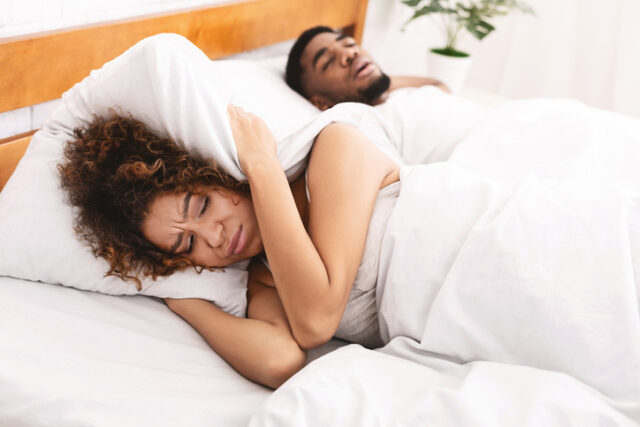
A Mayo Clinic study was the first to scientifically document what countless bleary-eyed spouses had long suspected: bed partners of snorers lose approximately one hour of sleep every single night. The research found that spouses were waking, at least partially, an average of 21 times per hour due to their partner’s snoring. When the snoring was eliminated through treatment, the partners’ sleep efficiency improved by 13 percent—translating to an additional 62 minutes of sleep per night. Multiply that across a year, and you’re talking about 365 lost hours of restorative sleep.
Partners of snorers report higher rates of depression, anxiety, morning headaches, and gastrointestinal complaints. They miss more hours of work. They have higher rates of insomnia. And perhaps most troublingly, research has found that sleeping next to a loud snorer can cause noise-induced hearing loss over time, with the ear closest to the snoring partner showing the most damage.
4. The “Sleep Divorce” Framing Might Be Part Of The Problem

Sleep researcher Dr. Wendy Troxel, a senior behavioral and social scientist at RAND and author of “Sharing the Covers: Every Couple’s Guide to Better Sleep,” has suggested rebranding the phenomenon as a “sleep alliance” rather than a sleep divorce. The terminology matters because it shapes how couples think about the decision and how others judge them for it. “Divorce” implies failure, conflict, the end of something. “Alliance” implies partnership, strategy, and two people working together toward a common goal.
Troxel’s research shows that up to 30 percent of an individual’s sleep quality is directly influenced by their bed partner’s sleep. When one partner has a sleep disorder, different temperature preferences, or a conflicting schedule, the question isn’t whether to be intimate or not—it’s how to structure sleeping arrangements so both partners can actually function. Framing separate beds as a collaborative solution rather than a relationship failure makes couples more willing to try it.
5. Sleeping Apart Might Actually Improve Your Sex Life

The assumption that separate beds mean less sex turns out to be largely unfounded. A 2024 survey found that 42 percent of couples who sleep separately believe it has “rejuvenated” their relationship, and 23 percent report that it has improved their sex life specifically. The logic is counterintuitive but sound: when both partners are well-rested, they have more energy, better moods, and greater desire for connection. Exhaustion is one of the most reliable libido killers, and chronic sleep deprivation creates the kind of irritability that makes physical intimacy feel like the last thing anyone wants.
Couples who sleep apart often report that separating sleep from sex has made both better. Instead of collapsing into bed exhausted and hoping for spontaneous intimacy that never materializes, they schedule time together intentionally—what some couples call “visiting rights.” The bedroom becomes associated with rest rather than resentment, and intimacy happens by choice rather than by default.
6. The Historical Norm Might Not Be What You Think

The expectation that married couples should share a bed every night is actually a relatively recent cultural development. For centuries, separate bedrooms were common among the European upper classes—a symbol of luxury and status rather than marital discord. It wasn’t until the sexual revolution of the 1960s that Western culture began equating the figurative meaning of “sleeping together” with the literal meaning, creating the assumption that sleeping apart signals a loveless or sexless union. The twin beds of I Love Lucy weren’t depicting reality; they were complying with the Hays Code, which prohibited showing couples in the same bed on television.
Understanding this history helps contextualize the current shift. Couples choosing separate beds aren’t abandoning tradition—they’re returning to one that predates the mid-20th century ideal. Many couples throughout history have maintained loving, intimate, lasting relationships while sleeping apart. The current generation is simply rediscovering what their great-great-grandparents may have known all along.
7. Sleep Deprivation Changes Your Brain Chemistry During Conflict

Research published in peer-reviewed journals has found that sleep-deprived couples show measurably different physiological responses during disagreements. One study randomly assigned couples to either a night of total sleep deprivation or a night of normal sleep, then had all couples discuss a topic of recurring conflict. The sleep-deprived couples showed higher cortisol levels during the conflict discussion, indicating that they experienced more stress and tension during the same type of conversation that rested couples handled more calmly. The sleep-deprived couples also reported fewer positive emotions both during and after the discussion.
Sleep deprivation has been linked to overactivation of the amygdala and decreased functional connectivity with the prefrontal cortex, the brain region responsible for emotional regulation and impulse control. In practical terms, this means sleep-deprived partners are neurologically primed to react more intensely, regulate their emotions less effectively, and handle conflict more poorly.
8. Different Chronotypes Create Compatibility Challenges

Research shows that couples with mismatched sleep-wake patterns report lower levels of relationship satisfaction, more conflict, and less sexual activity than couples who are naturally aligned. One partner wants to go to bed at 10 PM; the other doesn’t get sleepy until 1 AM. One wakes naturally at 6 AM; the other would sleep until 9 if given the chance.
The good news is that research also shows couples with good problem-solving skills can overcome the challenges associated with mismatched chronotypes. Some couples have found creative solutions: spending time together in bed before the early bird falls asleep, then having the night owl quietly leave; the night owl joining the early bird for morning coffee even if they return to bed afterward. But for many couples, the simplest solution is separate spaces where each person can honor their own biology without disrupting their partner’s.
9. The Real Estate Industry Has Noticed
The sleep divorce trend has become significant enough to influence how people shop for homes. A 2025 UK study found that 12 percent of couples now prioritize properties with additional bedrooms specifically for separate sleeping arrangements—not for guests, not for home offices, but for themselves. Architects and home designers are increasingly being asked to create “dual master suites” or bedrooms with adjoining spaces that allow couples to sleep apart while maintaining connection. The floor plan of the future marriage might look very different from the one-bedroom ideal of the past.
This shift has economic implications as well. Couples who might have bought a two-bedroom home are now looking for three bedrooms. Studio apartments and one-bedrooms become less viable for cohabiting couples who know they need separate sleeping spaces. The housing market is slowly adapting to acknowledge what couples have discovered through experience: the number of bedrooms in a home isn’t just about children or guests. It’s about whether two adults can both get adequate sleep.
10. COVID Accelerated Everything
When the pandemic forced couples into extended periods at home together, many stumbled onto an unexpected discovery: sleeping apart occasionally—out of necessity, due to illness concerns, or simply because one person needed to work late in a different room—led to better rest and better relationships. What might have felt like a drastic step before suddenly became normalized through circumstance.
Sleep researcher Dr. Troxel has noted that the pandemic offered “an experimental opportunity” for couples to try different strategies without the stigma of having chosen to sleep apart. Many discovered that what they’d feared would create distance actually created the opposite: mornings became more pleasant, evenings became more intentional, and the time spent together felt more valuable precisely because it wasn’t the exhausted, resentful proximity of two people who’d spent all night disrupting each other’s rest.
11. The Decision Has To Be Mutual To Work

Research and clinical experience both emphasize that sleep divorce only benefits relationships when both partners genuinely agree to it. When one partner feels banished, rejected, or forced into the arrangement, the psychological harm can outweigh the physical benefits of better sleep. Couples therapists report seeing cases where one partner loves the arrangement, and the other secretly resents it, leading to a different kind of distance than the one they were trying to solve.
The conversation matters as much as the decision. Experts recommend framing the discussion around mutual benefit rather than complaint, focusing on “how can we both sleep better” rather than “I can’t stand your snoring.” Couples who successfully navigate the transition typically maintain other forms of physical intimacy—cuddling before sleep, morning coffee together, and intentional time in bed that isn’t about sleeping.
12. It Doesn’t Have To Be Permanent

One of the most freeing realizations for couples considering sleep divorce is that it doesn’t have to be all-or-nothing, and it doesn’t have to be forever. Many couples sleep together on weekends and apart on weeknights when work demands make rest more critical. Others sleep apart during one partner’s illness, busy season, or treatment for a sleep disorder, then return to sharing a bed when circumstances change. Nearly 83 percent of couples who currently sleep separately believe they’ll end up sharing a bed again at some point.
This flexibility removes some of the weight from the decision. Trying separate beds isn’t signing a permanent contract—it’s running an experiment. Couples can test it for a week, a month, or a season and see how it affects their sleep quality, their daytime moods, their conflict patterns, and their sense of connection.
13. The Real Question Is What You’re Optimizing For

At the heart of the sleep divorce conversation is a question every couple eventually has to answer: what matters most? The symbolic value of sharing a bed, or the practical reality of how you treat each other during waking hours? The cultural expectation of what marriage should look like, or the actual quality of your partnership? The comfort of proximity, or the health benefits of genuine rest? There’s no universally right answer. Some couples truly sleep better together, finding comfort and security in physical closeness that outweighs any disturbances. For them, shared sleep is worth protecting.
But for the growing number of couples discovering that shared sleep is making them worse partners—more irritable, less patient, less healthy, less kind—the calculation looks different. They’re choosing to sleep apart, not because they love each other less, but because they’ve realized that loving each other well requires being rested enough to show up fully during the hours they’re awake.


